Wednesday, September 28, 2016

Side Hustle Week Day 3: Loanables And Craigslist

Source

Welcome to Side Hustle Week here at Road To A Tesla! Most personal finance bloggers love to talk about side hustles - ways you can make some extra money on the side to help you achieve your financial goals more quickly. These are usually jobs you can do as a hobby or while you are still employed full time somewhere and, with luck, you may be able to parlay them into big-time income producing projects.

I tried out my hand at some side hustles and each day this week, I will be posting my results and thoughts on some of the more popular ones.

Day 1 - Studypool
Day 2 - Wrapify
Day 3 - Loanables / Craigslist
Day 4 - Amazon Mechanical Turk
Day 5 -Udemy


Loanables / Craigslist


The Sharing Economy is the new Big Thing. Uber, Lyft, AirBnB,  and the like are letting people provide services or rent out their property for cash via the internet. In the case of the companies I mentioned, it’s been a pretty big success. It stands to reason then, that there might be an opportunity to rent out items besides cars or spare bedrooms.

Many people have stuff they rarely use – things like power tools, folding chairs, or sports equipment. Why not rent these out to people who need them? Back in 2008 and 2009, there was a big surge in websites specializing in these types of rentals. None reached the popularity of Uber or AirBnB and eventually the whole concept seemed to collapse. The largest company in the field, Zilok, is based in France and operates mainly overseas. Their U.S. site is still up, but you can no longer list an item to rent (you get an error when you go through the process) and the newest renter comments / evaluations I could find were from 2013. I read an article or two that posited that the failure of this concept to take off was due to the ubiquity of Amazon Prime, online ordering, and same- and next-day shipping.

Nevertheless, I felt the idea still had merit. I agree that cheap prices and quick delivery options from online stores are likely limiting how large this field can grow. Why rent a power drill for $10 a day when I can buy my own for $35, own it forever, and get it delivered tomorrow or sooner? But what about for large or heavy items, things that are generally hard or expensive to ship? Or items that are fairly specialized or needed only for a short time, such as crutches? I feel those might have a rental market.

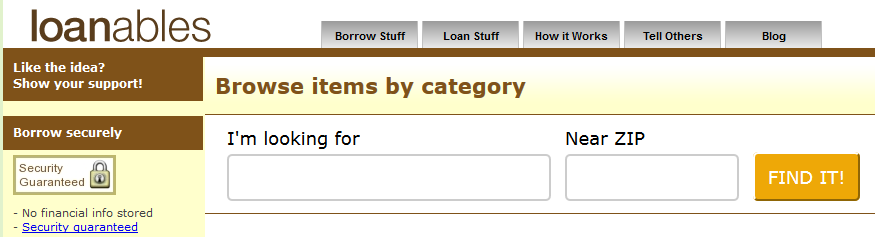
I searched for peer to peer rental sites and mainly found the husks of sites that went away years ago. However, I did come across one that was still functioning: Loanables. It’s a small site, but there were some people on there offering things to rent in my area, so I thought I would try them out. Their company blog hasn’t been updated in months and the comments on their last post seem to imply that it takes months before your items are approved and go live on the site. However, I found the site’s operators to be fairly responsive. They answered my emails usually within 1-3 days. They told me they approve and post items to the site every couple of days. In short, I think the site isn’t necessarily their top priority, but they are still working to keep it going.

The Process

I signed up as a lender. As part of that process, you need to provide a credit card number, which is not stored by the company and is handled by a third party company. The site is free for borrowers and charges a 10% fee for lenders, within a minimum fee of $1. The actual exchange of rental fees between borrowers and lenders is handled directly between the two parties, not the website. The site does collect a security deposit from the renter in case things go south, but they recommend the two parties work things out themselves in the case of damages, etc. rather than the lender simply requesting the deposit be turned over. The site provides a rental contract to protect all parties involved.

When you create your profile, you provide your address and a list of times that are most convenient for you to have the borrower come pick up whatever they rent. Your address is never released to the borrower until you have both agreed to a deal. If someone wants to rent one of your items, you can get an email notification, text message, or both.  Loanables' full FAQs can be found here.

To list an item, you fill out a simple form with a description of the item and indicate rental prices for daily, weekly, and monthly rentals, and a security deposit amount. You can upload a maximum of two photos. It’s a very simple and easy process. After the site’s owner’s have reviewed your listing, they will publish it to the site.

How It Turned Out


I listed 15 items to rent:


(Note: that image is from my admin screen. The page the borrowers see include images, descriptions, and more pricing.)

To date, I have not rented anything out and have not received any inquiries about my items. Given the failure of previous companies in this area, I have low expectations. However, it costs me nothing to have the listings up and the items I am renting are just sitting in my garage anyway, so even a single rental will see me make some money.


Craigslist


Craigslist is one of the largest and oldest classified advertising websites around and has separate sites for major metropolitan areas. The site has several different sections, such as For Sale, Jobs, Gigs, and Discussion, but not one for rental items. However, people do post things for rent in the For Sale area, so that is where I headed.

The Process

I've used Craigslist successfully before for selling various items, including my old car, so I was familiar with how the process worked. You create an account, log in, and a step-by-step process guides you through creating your ad. You can add photos and specify a general area of where you are located via Google maps. To verify your email, you'll be sent a link you need to click on before your post goes live. That email also contains a link to mange your ad - you can edit it later or delete it.

Because I already had done the work of photographing and writing descriptions for my items to post on Loanables, I figured I would go ahead and post some of the same items for rent on Craigslist. One thing I did add to my descriptions for Craigslist was that I would only accept cash, the renter would have to sign a rental agreement (this is done as part of the rental process on the Loanables website), and I would require a valid ID from the renter. This is just to protect myself from theft. Also, while I listed a maximum rental period of one month on Loanables, for Craigslist, I dropped that to one week. I only listed a subset of the items I listed on Loanables, mainly because you have to manage each ad independently, so it's a more cumbersome process than Loanables. Craigslist ads are valid for 45 days, after which they are automatically deleted.

How It Turned Out

I gotten two inquires on items so far, but nothing panned out. Again, it costs me nothing, so I’ll leave the posts up for now.


Tomorrow

So far, Side Hustle Week has been a bust. I have either made no money or made a small amount of money that I can’t withdraw. But things are about to take a turn for the better. I actually start making real cash. Come back tomorrow to see how!

Tuesday, September 27, 2016

Side Hustle Week Day 2: Wrapify

Source

Welcome to Side Hustle Week here at Road To A Tesla! Most personal finance bloggers love to talk about side hustles - ways you can make some extra money on the side to help you achieve your financial goals more quickly. These are usually jobs you can do as a hobby or while you are still employed full time somewhere and, with luck, you may be able to parlay them into big-time income producing projects.

I tried out my hand at some side hustles and each day this week, I will be posting my results and thoughts on some of the more popular ones.

Day 1 - Studypool
Day 2 - Wrapify
Day 3 - Loanables and Craigslist
Day 4 -Amazon Mechanical Turk
Day 5 -Udemy


Wrapify

You’ve probably seen the rolling billboards – cars wrapped with vinyl advertising copy cruising down the highway. I used to assume the cars were owed by the company doing the advertising – after all, my employer has a fleet of vehicles and they are all wrapped with ads for the company. However, it turns out this may not be the case. Those might simply be hired cars.

Wrapify is a company that sells advertising on cars. They pay you to get your car wrapped with vinyl advertising and then you go about doing your normal day to day driving and get paid for it. Sounds like a great, easy side hustle!

The Process

To qualify as a driver, you have to be at least 21 years old, have a clean driving record, and own or lease a 2008 or newer vehicle with no body damage. I signed up in July and learned how their process works.

Getting started is easy. You create an account on their website and download their app to your smartphone. When you go out driving, you launch their app, which uses GPS to track where you drive. If a company is interested in advertising in the area you drive in, you will get a notification to come in and get your car wrapped. (You always have the option to decline advertising for a company if, for example, you disapprove of their product.) Should you decide to go ahead and get your car wrapped, you drive to one of Wrapify’s service centers and drop your car off for the day. They wash it and apply the vinyl wrap, and then you pick it up. Wrapify will pay for an Uber or taxi to transport you to and from their service center while your car is being prepped. Then, simply drive your car as normal, being sure to run their app on your phone so you get credit for driving.

Advertising campaigns can last from 1 to 6 months, after which, Wrapify will remove the wrap from your car. You are paid only for driving within whatever area the advertiser selected and you are paid bi-weekly.

How It Turned Out

In order to be eligible for campaigns (which is what they call an ad), you have to first log at least 50 miles with the app. No problem. My daily commute is 52 miles, so I qualified the day I signed up. They also want to know what kind of car you drive, information they need to know so they can tailor the wrap to your specific car.

I dutifully turned on their app every time I drove my car anywhere. After more than a month of driving without getting an offer for a single campaign, I contacted the company and found out a bit more about how the process works.

Campaigns are only available when companies want to advertise, naturally. In my area (Phoenix), there were some campaigns active, but not many. The person I spoke with said their salespeople were attempting to sell more ads – after all, if the drivers don’t get paid, the company doesn’t get paid either – but it was slow going. To date, I’ve driven 3,357 miles without a campaign offer.

The App

Wrapify’s app comes in both an iPhone and an Android version. When I first joined, iPhone was all they supported and that is the one I used initially. That version works well. You just log in to the app when it launches and it simply tracks your mileage and route. You can get totals for the miles you’ve driven for the day, week, month, and year.


When you log into the website on your computer, you can also see maps of your routes, the times the app sampled your locations, and the speed you were driving. I will say that the speed number is way off. Most of my commute is freeway driving, where I am driving about 65 to 75 MPH. The app seems to think I’m only going around 35 MPH though.

The Android app was in beta when I started using it. It looks and functions identically to the iPhone version with one big exception – it drains your phone battery like crazy. I noticed after a 30 minute drive in to work, my battery typically dropped from 100% to around 50%. (I have a Samsung Galaxy S6.)

Even when you are not moving, the Android app sucks power. With the phone just sitting on my desk, by noon, my battery was dead. Now, this was a beta version, so things might have changed in newer versions, but the battery drain was so bad, I had taken to killing the app when I got to work to save the battery. The thing is, you can’t really do this because……

When a campaign becomes available in your area, you are notified via a push notification from the app. According to the company, campaigns are not tailored to a specific driver – the notification goes out to all drivers in the area and it’s assigned on a first come, first served basis. So you need to have the app running all the time and your phone with you all the time if you want to get and respond to a campaign offer. Here’s how the company explained it to me (grammar and punctuation as given):

We are active in the Phoenix metro however our advertisers are not currently running a campaign with open seats at the moment.  Because our platform is entirely advertiser dependent there will be a wait time for campaigns.
Here is some insight as to how the campaign matching works: Our advertiser sets up the area that the campaign will run when they are creating it in the system, they create the map or "campaign area" in which they want to pay drivers. Sometimes this will encompass the whole entire metro, and other times it's part of the metro, it's entirely up to them.  When the campaign goes live, the system will match the drivers that drive in that campaign zone that the advertiser has created. Those drivers that drive in that area will then receive the campaign via a push notification in the app. If a campaign goes live in your metro and you do not receive an offer that simply means your driving pattern does not fall within the advertiser desired campaign zone. Campaign selection is entirely up to the drivers who receive the offer, we do not choose the drivers for the campaigns and there is no priority seating. All offers that go out are first come first serve. Your driving data is not used for anything other than matching you with campaigns when they go live.
As long as you have the push notifications enabled on your phone you will receive the offers when they are activated in your area.

After three months, I have yet to receive any campaign offers. My daily commute is between the Phoenix metro area and a nearby suburb, so either I don’t fall into the area the advertisers are looking for, or  there just isn’t anyone advertising.

Conclusion

I’d like to see this side hustle work. Even without getting selected for a campaign, it’s not too much hassle to continue to make yourself available for when a campaign kicks off. I rarely leave the house without my phone anyway, so there is very little in my routine that I have to change to keep myself available for a potential campaign.

Obviously, the area you drive in will have a huge impact on how successful this side hustle can be for you. Those living in sparsely populated, rural areas are probably not going to get much income from this side hustle.

While I have not made money with this yet, I’ll keep using the app for a bit and continue to see how it plays out. I imagine though, that after more than a couple months without an offer, I'll probably give it up.

Monday, September 26, 2016

Side Hustle Week Day 1: Studypool

Source

Welcome to Side Hustle Week here at Road To A Tesla! Most personal finance bloggers love to talk about side hustles - ways you can make some extra money on the side to help you achieve your financial goals more quickly. These are usually jobs you can do as a hobby or while you are still employed full time somewhere and, with luck, you may be able to parlay them into big-time income producing projects.

I tried out my hand at some side hustles and each day this week, I will be posting my results and thoughts on some of the more popular ones.

Day 1 - Studypool
Day 2 - Wrapify
Day 3 -Loanables and Craigslist
Day 4 - Amazon Mechanical Turk
Day 5 - Udemy


Studypool

Studypool.com is a tutoring website where students post questions or requests for help and others can assist them - for a fee. Each question posted has a dollar range that the student is willing to pay for assistance, as well as a time frame they need the answer by. As a tutor, you place bids on the questions and feel you can answer, sort of like an auction.

They have a reputation system for both students and tutors, but it’s fairly rudimentary. As a tutor, you can increase your reputation by just submitting 15 or more bids in a day. The bids don’t have to be accepted by any students for you to get the increased reputation.

 The Process

Once your bid is accepted, Studypool has a very specific process you must go through to help the student. You are forced to send a “Hello” message to the student and tell them when they can expect your answer. Then you send them your answer.

This is where things get strange. To get credit for submitting an answer, you have to mark the question as completed before the end of the time frame the student specified, but the next step in their process is to answer any additional questions the student might have. So if you never hear back from the student, which happened to me 100% of the time, technically, you can't mark the question as complete because you don't know if the student has other questions. I ended up waiting until 5 or 10 minutes before the time frame was to end, then marked it as complete. And finally, in order for you to get paid, the student has to mark your answer as acceptable.

How It Turned Out

I had many issues with the site: They break down questions into categories, but they are seemingly random. For instance, they have three separate categories called Mathematics, Algebra, and Calculus. Mathematics is a general enough term to cover algebra and calculus, so not sure why those are broken out separately. They should just use the two more specific terms and ditch the Mathematics category. Other categories include Graphs, Film, SAT, and Excel. They have separate categories for Programming, PHP, HTML/CSS, Javascript, and Computer Science, even though they are all Programming.

The site is fairly slow. Additionally, they use a spinning wheel graphic at the end of their search results. This makes you think the site is still working, but in reality, it’s done. Very poor user interface design.

The questions themselves range from the ridiculous to the absurd. I’ve seen questions asking to explain the Pythagorean Theorem or how to graph X=5 and ones asking for an 18 page paper on economics. The students seem to have little sense of value. For example, the question that required an 18 page paper was set with a maximum price of $10. I feel I am competing against people in third world countries for working at that price.

Many students often post questions with instructions like “Use the methods discussed in class…” Umm.. We weren’t in the class. How are we supposed to answer that? Or look at this one:

“Read chapter 13 and 14.” Said chapters are nowhere to be found. Not even a name of a book to try to find them. The required deliverable is a two page essay. Want to know what the student was willing to pay for this? $1 to $7. Oh, and the student wanted this done within 15 hours. Place your bids now to compete for the right to answer this one!

Worst Auction Ever

And speaking of competing, there is next to no way to distinguish your bid from others. Bid amounts are limited to a list in a drop down box that only contains values within the question’s listed price range – and those are only in $2 increments. If you see 5 people bidding $5 on a question and you want to bid $4, too bad. Can’t do it. You’re stuck bidding $3.


The only way to differentiate yourself from other tutors is by your reputation score. However, this presents a catch-22. You can’t raise your score until you answer questions and no one will pick you to answer questions if your score is low. You can raise your score, as I mentioned earlier, by bidding on 15 or more questions per day. This, of course, opens the door to artificial reputation inflation.

Not Much Work Available

Questions are very hard to come by. I signed up in July, when school was out, so I can understand the initial lack of questions. However, I continued to search for questions once or twice per day until the end of September. The pickings were slim. Once again, I felt I was up against hordes of people overseas who spend all their time on this site, snatching questions up as soon as they become available.

Studypool started a new feature shortly after I joined – something called “Recommendations.” Basically, Studypool will recommend a particular tutor to the student to answer a student’s question. (It's unclear if this is an automated process or not.) Here's how they explain it:


There are several factors in determining if a recommendation gets made, including price and time limit, satisfaction rate (i.e, a tutor’s reputation rating), etc. The problem is that once Studypool has made a recommendation, no one else can view or bid on the question. This drops the number of available questions to miniscule amounts. Here is an example of what I have seen every day for the past month:


Everything grayed out is non-bidable due to a recommendation. There is only one available question (at the top), and this is searching ALL questions on their site.

So to recap – questions get a recommendation about 20 minutes after being posted. Once a question has received a recommendation, no one else can bid on it (or even view it). This means you have to monitor the site constantly in hopes of getting a question you can bid on.

Payments

After answering 10 questions, new tutors get a $25 bonus. I never made it that far. I was only able to answer 3 questions, earning a total of $11 in pay. Unfortunately, the site does not let you withdraw money until you have accumulated at least $50.

The Final Word

Let’s be honest - with this site, you are getting paid for doing someone’s homework. Even if you are OK with that, your time will best be spent elsewhere. Unless you are dirt poor and willing to work for pennies an hour, avoid this one.


Wednesday, September 21, 2016

The Facebook Challenge


For some reason, it’s taboo in our society to talk about how much money you have. I do understand the desire for privacy and safety, but I don’t fully understand the reluctance to discuss finances. While I wouldn’t want to tell people “I’ve got $100,000 in small bills hidden under my mattress and, by the way, I’m going out of town next week,” I don’t see the harm in saying “I’ve got $100,000 saved in my brokerage account for retirement.”

This taboo against talking about money just causes problems. If you can’t discuss finances with others, how do you learn? You can't. How do you know what you are doing wrong and what you are doing right? You don’t. So our society continues on with most people living paycheck to paycheck, barely making ends meet, just one small disaster away from financial collapse.

Forty six percent of Americans can not handle a $400 emergency expense. Almost half of all Americans! That’s a recipe for disaster. You WILL face an emergency expense at some point. Life happens. You have to be prepared for it.

Americans don’t like talking about money, but they sure love to curate their life. (That's a fancy way of saying they love showing off.) Facebook is filled with pictures of the new car your friend bought, or the new house your sister bought. Your friend from eighth grade just posted a picture of the $200 sneakers he bought his seven year old son. Who's that standing in front of the Great Pyramid Of Giza? Oh, it’s your old roommate from college who was always late with his half of the rent!

Add to this the relentless messaging from advertisers that tell you that you must spend money in order to be happy and you can see why people are living paycheck to paycheck. The forces urging you to keep up with the Joneses are everywhere.

No one on Facebook posts a picture of the $5,700 credit card bill they got in the mail yesterday. No one posts photos of the depressingly small balance in their 401(k) or their kid’s college saving account. Social media lets us present ourselves to our friends as we wish to be seen – successful, happy, and well-off. We share photos of the $300 meal we had for our special night out but we don’t post a photo of the actual bill. We share the fun times. We don’t share the times life sucks.

All those carefully selected images give us a skewed view of how life really is and that results in a yuge amount of peer pressure to try to live that fantasy life. We can’t help but think that if we aren’t living in a similar fashion, we must be doing something wrong.

Stop it.

Let’s harness that peer pressure for something good. Let’s take away the stigma of talking about money or being in debt. Let’s discuss our finances amongst our friends and learn from each other. Let’s all help each other improve our financial lives.

I’m going to issue you all a challenge:

Post your net worth on Facebook.

Did you just wet your pants? Maybe a little? Sure you did. Here:

Too little, too late

This is a scary thought. Display your crappy financial situation for everyone to see? WTF! No way!

I admit, I had the same thoughts when I first contemplated posting my net worth on this blog. Ultimately, I decide to face my fears and go through with it anyway. For me, the issue wasn’t so much shame – after all, our net worth is pretty high and we’re definitely in better financial shape than the majority of Americans. My battle was against the stigma of talking about finances. If our net worth was really low, or even negative, in addition to fighting that stigma, I would have also had to face the additional fear of being embarrassed. Those two fears are probably too much for some people to overcome.

Let’s change that. We’ve all screwed up. We’ve all done stupid things and have gotten in over our heads. Tell your friends about it. Post your net worth.

We need some rules, though, so here's some suggestions:

Be smart in what you share. Don’t share personally identifiable information. Don’t post your social security number or your credit card number. Remember Facebook may share your address and phone number with friends if you’ve allowed it to, so don’t list “$10,000 cash under the sofa cushions in the living room” on your net worth statement unless you want your house broken into.

No judging. Posting financial details is scary. You're exposing a vulnerability and that requires a huge leap of faith that those you are sharing with won't abuse it. We’re here to help fix problems, not critique lifestyles.

Be helpful, not hurtful. Everyone’s situation is different. Everyone has different priorities. There’s more than one way to do things. You'd do well to keep in mind Star Trek’s philosophy of IDIC: Infinite diversity in infinite combinations.

Look forward, not back. What’s done is done. Let’s concentrate on how to improve things, not how messed up things were in the past.

Offer constructive advice or encouragement. Build up, don’t tear down. Specific steps to take going forward are more useful than theoretical ideas.

No jealousy or panhandling allowed. Don’t ask people in a better financial situation than you for loans or handouts. It puts the person you are asking in an awkward position and increases the odds of hurt feelings if you don't get the reply you want. You are the captain of your destiny. Accept that responsibility. When you finally reach your goal, you’ll appreciate the accomplishment that much more for achieving it all on your own. Ask for advice, not money.

Show respect. For each other and for each other’s choices.

Use Facebook’s privacy settings. If you don’t want to entire world to know your net worth just yet, change the settings on your post so that only your friends can see it. Or friends and friends of friends. Whatever.

How do you get started?

If you don’t know how to calculate your net worth, it’s not hard. Add up the value of all your stuff – house, car, bank accounts, 401(k), etc. For simplicity, don’t include small stuff like your stereo. If it’s worth less than $500, ignore it. These are your assets.

Add up all of your outstanding bills – mortgage, credit card balances, student loans, etc. Include everything you owe money on. These are your liabilities.

Your net worth equals your assets minus your liabilities. Figuring out all these numbers might take a little bit of work, but then, anything worthwhile usually takes a little bit of work. (Mint.com is a great site that does this calculation automatically for you after a one time step of setting up everything. I use it and recommend it.)

You want your net worth to be a positive number. You also want it to be as big as possible. In fact, that is your goal – to increase this number every month.

Post your number to Facebook. You can post just a number or you can post your breakdown of assets versus liabilities. Whatever you want. But post something.

This does two things:

  1. By posting this on a regular basis, you become accountable for it. You’ve now got people watching your progress, so you’re more likely to succeed. This is the concept behind Weight Watchers. This is peer pressure for the common good.
  2. You can see others aren’t so different from you. Everyone fucks up. Everyone can make it better. Life is not always vacations and $200 sneakers. Life is sometimes delaying gratification so you can retire a bit earlier and not have to work until you are 75 years old.
I’ve thrown down the gauntlet. Let’s stop the silence and shame of financial illiteracy. Are you with me?


P.S. I can’t say this idea was all mine. I first read about it from Kurt at MyMoneyCounselor and I’m sure others before him have suggested the same.